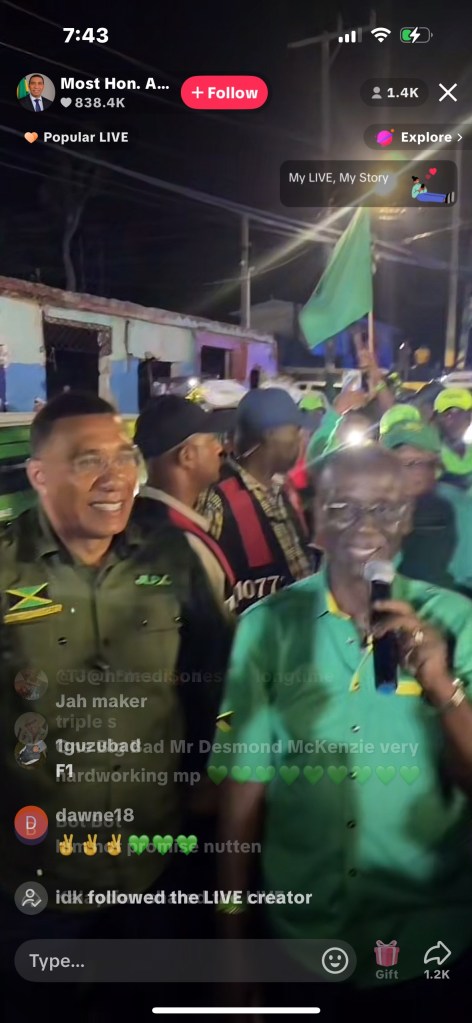
Prime Minister Andrew Holness recently embarked on a marathon live stream, broadcasting his journey through rural Manchester. As an independent journalist, I followed the event from a distance, documenting the real-time reactions of both the Prime Minister and the people through the lens of my screen. This was not a typical broadcast; it was a 12-hour-plus event that started in the morning, showing a level of direct engagement rarely seen from a head of state.
What I observed was a powerful display of a new type of political communication. In the comments section, viewers praised the Prime Minister’s approach. One user, “DR3A,” commented that they liked “that he drive around to campaign while seeing the place for himself on where can be develop.” Another, “WifeMomBoss,” said they loved “to see him interacting with Jamaicans from all over and especially children.” On the ground, the connection seemed just as strong. Viewers reported seeing people fanning him down, holding on to him, and stopping to take pictures with him and their families.
However, the event also highlighted the tension between this new digital engagement and the on-the-ground reality. Amidst the praise, other viewers used the platform to voice their concerns. One comment from “Child-of god” highlighted a specific issue, writing, “This road can’t fix quarry.” This showed a clear desire from the community to see real, tangible change beyond the live stream.
In the end, the live stream was more than just a political broadcast. It was a powerful display of a new type of political communication. As one person put it, “even if it’s a facade it looks good.” This suggests that in the new age of politics, the very act of showing up and connecting with the people, in a raw and personal way, may be just as important as the actions that follow. The mute button during his downtime—which people were asking about—was a reminder that even in this raw display of engagement, there are still layers of professional security and strategy at play.
 The Daily Prism
Leave a comment